
Glossary · commercial pool service and pool management
The words behind every chemistry log.
Forty-nine terms that commercial pool service and pool management companies use every week — the pools and spas, the plant room, the water chemistry and the records — each in a line or two of plain English, with a note where Limparo uses the term.
Coming soonLaunching soon
Request waitlist accessContents
49 terms in four groupsA commercial pool, in section
Where the water goes.
Most of a commercial pool is out of sight: the water spills into the gutters, collects in a surge tank and runs through the plant room before it comes back. The numbers match the terms below.
49 terms shown
No term matches. Try a shorter word.
Pools and spas
The water you look after, by type.
- Commercial pool
Any pool used by the public or by a defined group — a hotel’s guests, a club’s members, a community’s residents — rather than one household. Commercial pools are usually inspected and expected to keep written records.
Also called public pool, semi-public pool
- Spa
A small pool of hot, aerated water. Hot water and several bathers in a small volume use up sanitizer fast, so a spa needs closer watching than the pool beside it.
Also called hot tub, whirlpool
- Lap pool
A long pool laid out in lanes for swimming lengths, from a hotel’s fitness pool to a 25-metre or 50-metre competition pool.
Also called competition pool
- Teaching pool
A shallow, often warmer pool for lessons. Warm water and young bathers make its chemistry move faster than the main pool’s.
Also called learner pool
- Wading pool
A very shallow pool for small children. Little water and heavy use make it one of the hardest pools to keep in range.
Also called paddling pool
Circulation and the plant room
From the gutter to the return inlet.
- Plant room
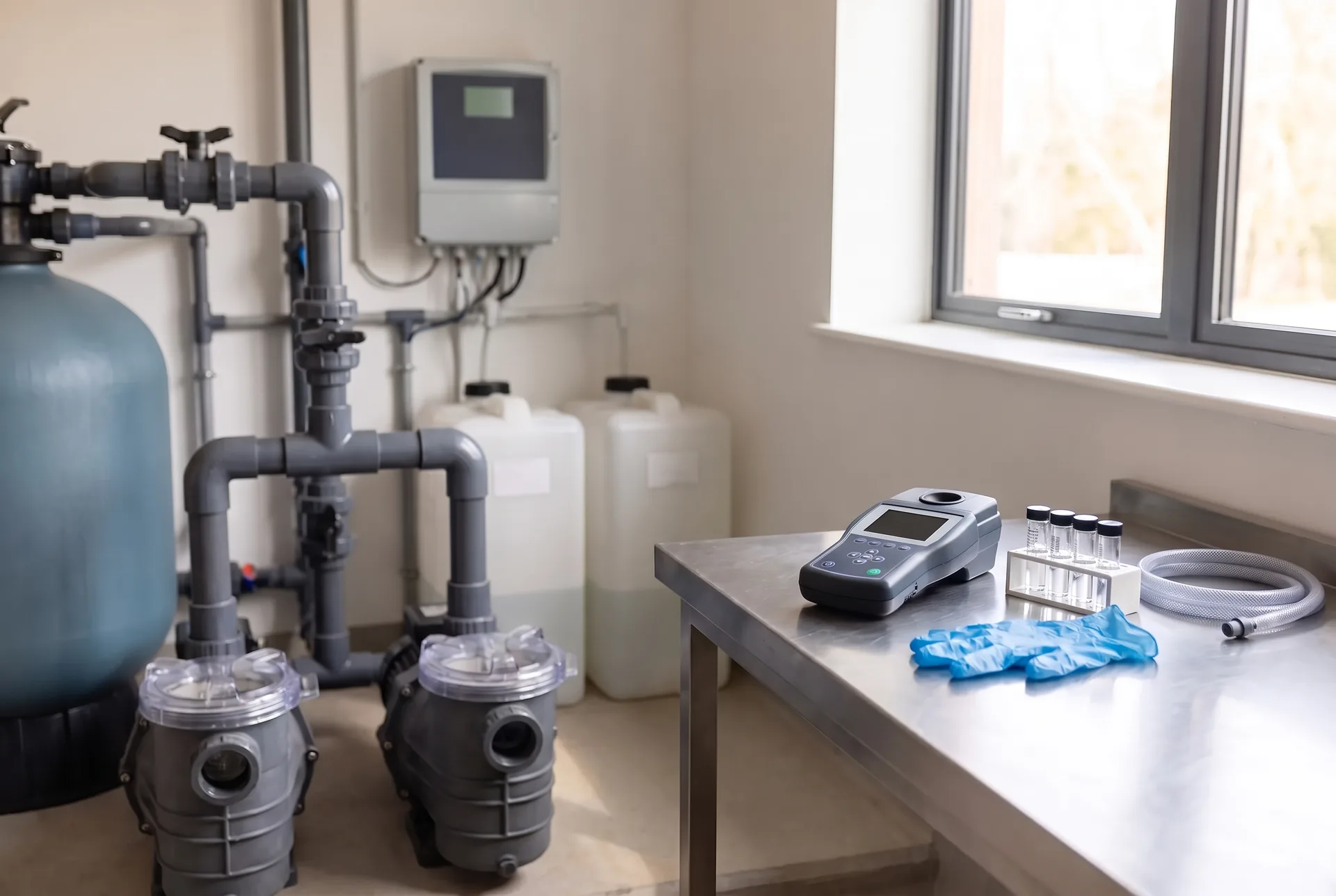
The room that holds a pool’s pumps, filters, heaters and chemical equipment — where much of a service round happens.
Also called pump room, mechanical room
- Main drain
The outlet at the deepest point of the pool floor that draws water to the pumps. Its grate is checked on every round for damage and a secure fixing.
Also called bottom drain
- Skimmer
An opening in the pool wall at the water line that draws off the surface water, with a basket that catches leaves and debris.
Also called surface skimmer
- Perimeter gutter
An overflow channel around the edge of many commercial pools: water spills over its lip, taking the surface film with it, and flows to the surge tank.
Also called overflow gutter, deck-level gutter
- Surge tank
The reservoir the gutters drain into. It absorbs the water bathers push over the edge and keeps a steady supply in front of the circulation pumps.
Also called balance tank
- Hair and lint strainer
The basket housing in front of the circulation pump that catches hair, lint and debris before they reach the impeller.
Also called pump strainer, pump basket
- Circulation pump
The pump that moves the pool’s water through the strainer, filter, heater and treatment and back through the return inlets, around the clock.
- Turnover
The time it takes for the pool’s whole volume to pass through the filter once. Busy pools and spas need shorter turnovers.
Also called turnover rate
- Flow meter
A gauge on the return pipe that shows how much water is circulating, so a dirty filter or a tiring pump shows up as a drop in flow.
Also called flowmeter
- Sand filter
A pressure vessel packed with filter media; particles stay behind as water is pushed through it. A rising pressure difference across the vessel is the cue to backwash.
- Cartridge filter
A filter that traps dirt in pleated fabric cartridges, which are taken out and cleaned or replaced instead of backwashed.
- Backwash
Reversing the flow through a sand filter so the dirt it has caught goes down the drain; the valve then goes back to filter.
Also called backwashing
- Heater
The equipment that keeps a pool or spa at its set temperature. Warmer water uses chlorine faster, so the heater shows up in the chemistry too.
Also called heat exchanger, heat pump
- UV system
An ultraviolet lamp in a chamber on the return pipe that treats the water as it passes, working alongside the chlorine and helping break down chloramines.
Also called UV reactor
- Chemical controller
The panel that measures the water continuously through probes — usually pH and ORP — and switches the feeders on and off to hold them.
Also called automatic controller
- Chemical feeder
The pump or feeder that doses chlorine, acid or another product into the circulating water, under the controller or on its own setting.
Also called feed pump, doser
- Return inlet
The fittings in the pool wall or floor where filtered, treated water comes back in. Their direction keeps the whole pool circulating.
Also called return jet
- Autofill
The make-up line that refills the pool on its own when the level drops — after evaporation, splashing or a backwash. If it starts adding much more than usual, look for a leak.
Also called water leveler, automatic fill
Water chemistry
What is tested, and why it moves.
- Chemistry log
Every test result for one pool or spa, kept in date order with the products added and anything done to correct the water. Limparo keeps a separate log per pool and per spa.
- Range
The low and high limits you set for a reading on a given pool or spa. Limparo is built to flag anything outside them and ask for the corrective action.
- pH
The measure of acidity in pool water. Chlorine works best within a narrow pH band; drift either way and the water stings, scales or eats metal.
- Free chlorine
The chlorine in the water that is still available to sanitize — the reading that matters most for keeping bathers safe.
Also called FC, free available chlorine
- Combined chlorine
Chlorine that has already reacted with sweat, urine and other nitrogen compounds — the cause of the “chlorine smell” and stinging eyes. It is total chlorine minus free chlorine.
Also called chloramines
- Total alkalinity
The water’s buffer against changes in pH. Low alkalinity lets pH swing; high alkalinity makes pH hard to move.
Also called TA
- Cyanuric acid
A stabilizer that shields chlorine from sunlight in outdoor pools. Too much of it slows chlorine down, and it only leaves the water by dilution.
Also called CYA, stabilizer
- Calcium hardness
The calcium dissolved in the water. Too little and the water takes calcium from grout and plaster; too much and it leaves scale.
Also called CH
- TDS
Everything dissolved in the water. It climbs as products are added and water evaporates; diluting with fresh water brings it down.
Also called total dissolved solids
- Water balance
Whether the water is neither corrosive nor scaling, worked out from pH, alkalinity, calcium hardness, temperature and TDS — often as a saturation index such as the LSI (Langelier Saturation Index).
Also called saturation index
- ORP
A measure, in millivolts, of the water’s power to oxidize. Controllers use it to judge when to add chlorine.
Also called oxidation-reduction potential
- Bather load
The number of people in the water over a period. It drives how fast chlorine is used and how much waste goes into the pool.
Also called bather count
- Superchlorination
A deliberate high dose of chlorine to burn off combined chlorine and organic waste, usually after heavy use.
Also called shock, shocking
- Breakpoint chlorination
Adding enough chlorine to destroy the combined chlorine completely — past the point where free chlorine starts to rise again.
Also called breakpoint
- DPD test
The common colour test for free and total chlorine: a reagent turns the sample pink, read by eye against a scale or with a photometer.
Also called photometer test
Service rounds, records and the trade
The visits, the paperwork and the people who do it.
- Service round
One visit to a facility, with the work done at each of its pools and spas: readings, equipment checks, cleaning, products added and corrective actions.
Also called service visit
- Corrective action
What was done about an out-of-range reading or a deficiency — adjusting a feeder, superchlorinating, closing a spa — pinned to the day’s log with who did it and when.
- Retest
A second reading after a corrective action, to show the water is back in its range.
- Deficiency
A gap between what should be and what is — a loose drain grate, a failed feeder, a gate latch that won’t close — recorded and followed up until it is closed.
- Equipment at spec
Comparing the equipment list a facility is meant to have with what is actually there and running; anything absent or broken is marked below spec.
Also called facility specification
- Chemicals added
The products put into each pool or spa on a round, and where they went — the record of use the client can see.
Also called product use
- Pool Service Record
In Limparo, the report the client keeps: the chemistry log against each pool’s ranges, equipment status, deficiencies and corrective actions, photos, and a summary drafted for you to edit before sending.
- Work Record
In Limparo, one job written up: the steps in the order they were done, photos before and after, the parts used and the hours on site. It sits in the pool’s history, and the client gets it whenever you decide to send it.
- Pool management company
The usual US name for a firm that runs commercial pools for their owners — HOA, community, club and hotel pools — for the season or the year: the chemistry, the equipment, the inspections and often the lifeguards. Limparo is built for the water and records side of that work.
Also called pool management firm, aquatic management company
- Certified Pool Operator
A widely held US credential for the people who run and maintain commercial pools, covering water chemistry, filtration, equipment and safety. Many public pools are expected to have a certified operator responsible for them.
Also called CPO
- Health inspection
A visit by the local health authority to a public or semi-public pool to check the water, the equipment, the safety features and the written records — the chemistry log is usually among the first things asked for.
Also called pool inspection
Logs and reports are formatted to support regulatory submission; operators remain responsible for jurisdictional compliance.
Keep reading
Where these words do their work.
- Every pool and spa on recordThe service round pool by pool: readings against their ranges, corrective actions, equipment at spec, the Pool Service Record.See the records
- Pools and spas at hotelsBusy weekends, hot tubs and a brand that asks for ninety days of records in one afternoon.See hotel work
- Public aquatic centersFive bodies of water under one roof, heavy bather loads and a contract that is judged on every closure.See aquatic center work
Founding access
Be first when Limparo opens.
Limparo is taking shape for the firms that use these words every day: a chemistry log for every pool and spa, corrective actions on record, equipment at spec and a Pool Service Record the client keeps. Early access for founding customers, and news when it launches.
Launching with a 14-day free trial. No card needed.
Coming soonLaunching soon
Request waitlist access